If you’re discussing supply chain initiatives with Amazon, chances are your Vendor Manager has pitched you a programme called WePay (aka Amazon Collect).
It removes the need to hire your own carrier and allows Amazon to collect Purchase Orders directly from your warehouse.
The big question is:
Should you and your teams consider an investment? What are the advantages and disadvantages of this initiative? And how should you calculate the business case?
In this guide, you will learn:
- What Amazon WePay is
- Why Amazon prioritises WePay
- The benefits of WePay
- The risks of WePay
- How to approach WePay in AVNs
Let’s dive right in!
What is Amazon WePay?
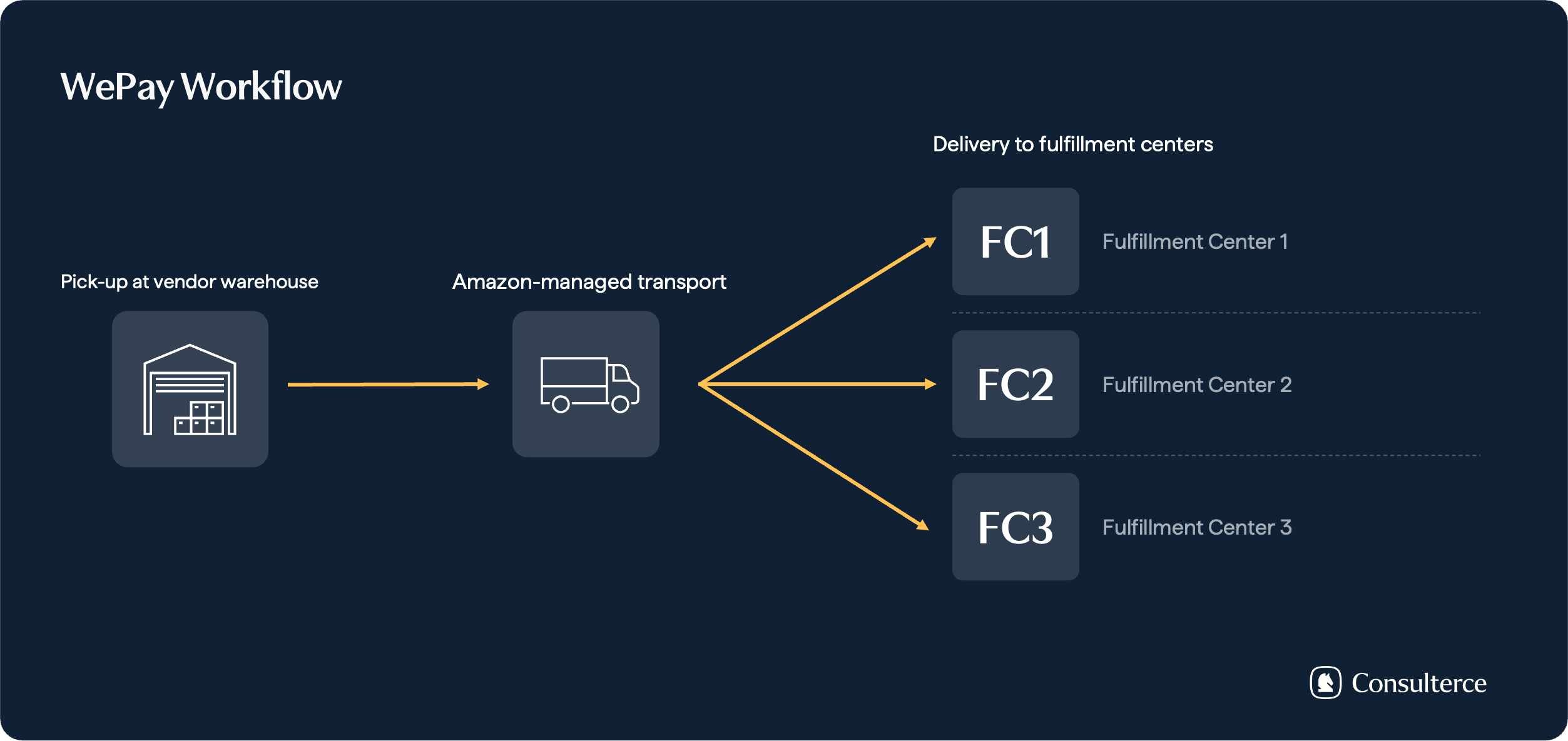
Amazon WePay is a freight model in which Amazon collects goods directly from your vendor warehouse using its own carrier network.
As a result, you as the vendor no longer manage the inbound transport. Instead, Amazon takes over the carrier selection, pickup scheduling, and delivery into its FC network.
In Europe, WePay often replaces existing setups like PICS (Amazon’s Pan-European Inbound Consolidation Service) and Super PICS. In turn, vendors often benefit from more consolidated orders when moving to a WePay setup, as Amazon seeks to maximise their truck utilisation.
The reasons behind Amazon’s push for WePay
Vendor Managers have started to become more progressive in their approach to pitching WePay to 1P brands selling to Amazon. The motivations behind are strategic.
Supply chain programs like WePay allow Amazon to gain greater control while unlocking efficiencies in how inbound shipments are managed across its network.
There are three core drivers behind this push:
1. Greater flexibility and control
Amazon gains end-to-end visibility and execution control over inbound flows. This reduces dependency on vendor performance and third-party carriers, allowing Amazon to better react to:
- Delayed shipments
- Inconsistent vendor execution
- Sudden demand spikes
2. Improving network density
By aggregating freight across vendors, Amazon can optimise:
- Truck fill rates
- Routing efficiency
- Cross-dock utilisation
And the more volume Amazon controls, the more efficiently it can move goods through its fulfilment network.
3. Pivoting between strategic initiatives
Programs like Amazon’s One-Grocery-DC, regionalisation, and ultra-fast (30-minute) fulfilment models rely on tighter inbound control.
When Amazon owns the inbound model, it can dynamically re-route shipments to the facilities where inventory is needed most, reducing out-of-stocks and improving delivery speed.
Evaluating the benefits of WePay: operational advantages
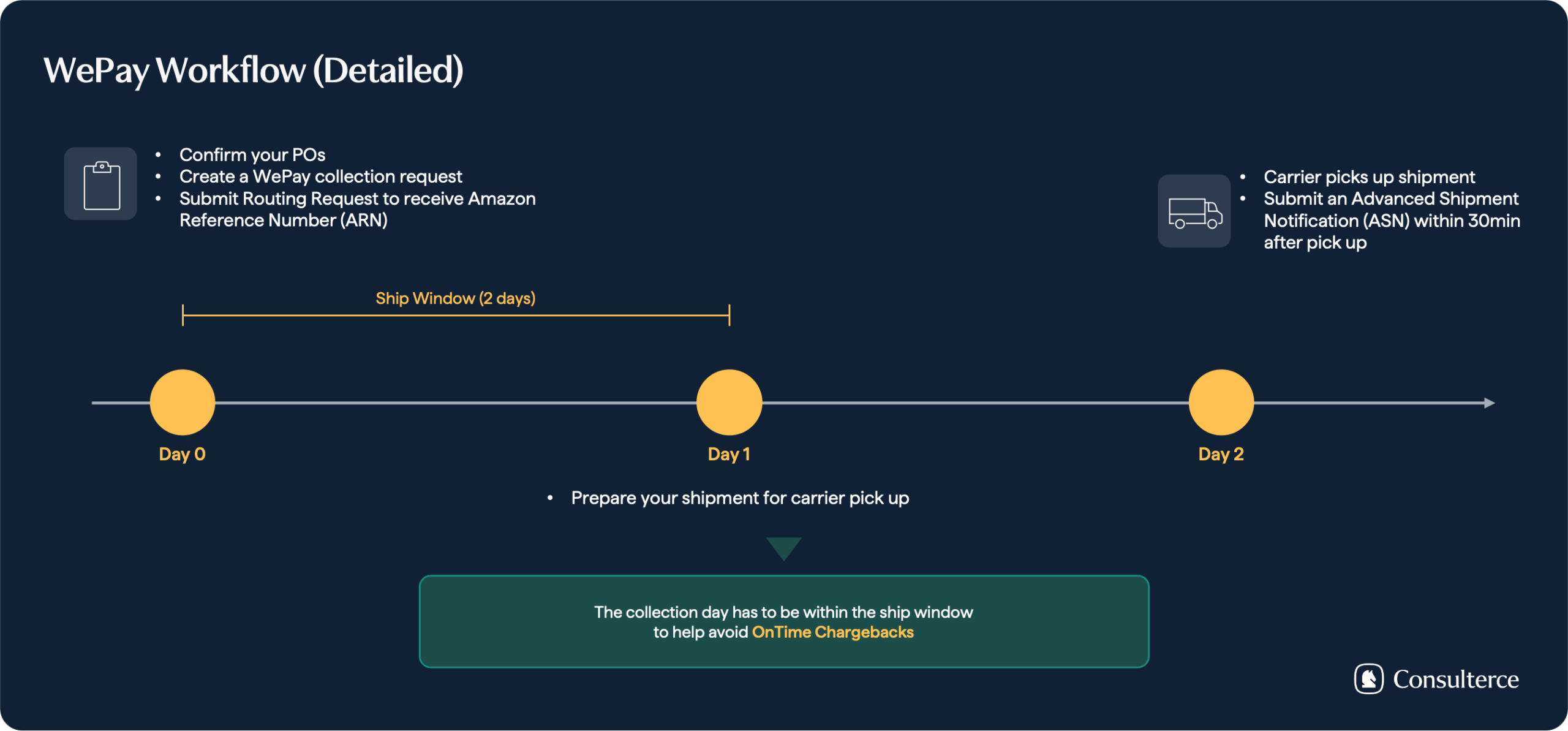
There are clear operational advantages to WePay, particularly if your current inbound setup is resource-heavy or inconsistent across markets:
Lower operational burden
- Less hands-on responsibility for freight execution
- Avoids negotiating the introduction of new lanes with carriers
- Simplified inbound logistics processes
Onboarding to WePay is particularly valuable for organisations with lean supply chain teams or fragmented carrier setups across North American and Pan-European locales.
Improved compliance and fewer penalties
- Fewer chargebacks linked to routing, booking, and delivery non-compliance
- Lower risk of missed delivery windows
- Moderate reduction in shortages and discrepancies
WePay allows vendors to align more closely with Amazon’s preferred processes, which reduces hidden cost centres in the customer P&L.
Better alignment with Amazon’s ways of working
- Easier integration with Amazon’s One-Grocery-DC and regionalisation initiatives
- Priority FC inbound receiving compared to non-WePay shipments in peak (Q4) periods
- Ability to bypass delivery window constraints and negotiation of delivery window extensions
Onboarding to Amazon WePay can directly translate into better in-stock performance and more consistent lead times for 1P vendors.
Assessing the risks: strategic and operational trade-offs
While WePay can offer significant operational and financial benefits, it also introduces a set of strategic and operational trade-offs that vendors should carefully evaluate:
Loss of control over inbound logistics
- Carrier is selected by Amazon
- Limited influence over pickup timing and execution
- Risk of late or missed pickups, especially in peak periods
Over time, this means vendors lose ownership of their supply chain and become increasingly dependent on Amazon’s execution.
Commercial uncertainty
- WePay rate cards are negotiable but can change during AVNs
- No guarantee of full pallet or full truck ordering
- Chargebacks and shortages do not entirely disappear
An overly optimistic WePay business case can become less compelling as terms evolve and assumed efficiencies fail to materialise.
Supply chain friction
- Risk of cancelled pickups if shipments are not fully prepared at the scheduled pickup time
- Reduced ability to optimise fulfilment structures across channels
- Removing Amazon’s volume from your own carrier contracts can weaken your negotiation position with logistics partners for other channels
WePay introduces the risk of a more fragmented supply chain, where gains in one area are offset by inefficiencies elsewhere.
How to approach WePay in Annual Vendor Negotiations (AVNs)
To onboard vendors to WePay, Amazon requests a Freight Allowance, expressed as % of your Net Sales (Net Receipts). This is where most of the financial risk sits, and where your preparation needs to be significantly more rigorous than in a standard AVN discussion.
Start by gathering an overview of your current logistics costs across existing carrier lanes and markets. You want to compare Amazon’s rate card with your true cost-to-serve and factor in the knock-on effects of removing Amazon’s volume from existing carrier contracts.
I highly recommend approaching WePay discussions at the regional Pan-EU level rather than at a country-by-country level.
Keep in mind that while WePay can reduce certain chargebacks and operational complexity, it does not fully eliminate them.
Your objective should be to run WePay at a cost advantage, or at least cost neutrality. To do that, you must actively challenge Amazon’s cost assumptions. Vendor Managers often build a margin padding into their proposed Freight Allowance, so it’s critical not to accept the initial rate proposal at face value.
Beyond the commercial calculation, the scope and structure of the WePay agreement matter just as much.
Make sure the agreement clearly addresses:
- Expectations on full pallet or full truck load ordering from Amazon
- Fixed pickup slots, which are especially critical during peak periods like Q4
- Liability and cost ownership for missed or delayed pickups
Ultimately, WePay should be treated as a cost-saving initiative. If the only cost-saving lies with Amazon, it’s better to walk away from its implementation.
Final thoughts
Amazon WePay has gained significant traction in recent years as it promises cost efficiencies and addresses key pain points for 1P vendors, particularly around chargebacks, shortages, and shorter delivery windows.
However, the often aggressive Freight Allowance demands from Vendor Managers require a thorough internal cost and risk analysis, especially ahead of your next annual vendor negotiation. Otherwise, there is a real risk of accepting terms that benefit Amazon more than your own business.
Want support assessing your WePay business case?
If you’re looking for support to negotiate WePay as part of your AVN with Amazon, get in touch. I offer tailored consulting services that help 1P brands run a profitable business with Amazon.