
If you’re trading with Amazon, you know that the online retailer regularly offers to place bulk buys (aka Spectra buys) in exchange for cost price discounts.
Bulk buys offer brands an opportunity to increase their sell-in to Amazon. But the associated costs can cause significant problems down the line.
So if you ever wondered whether to accept or deny bulk buy offers from Amazon, you’re in the right place.
In this article, I’ll explain:
- What bulk buys are
- Amazon’s motivation behind bulk orders
- Why vendors should reject most bulk buys
- When to strategically accept them
Let’s get into it.
What are Amazon bulk buys?
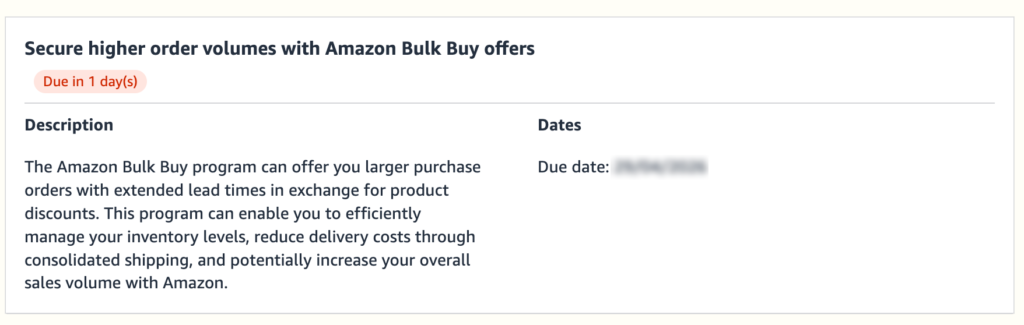
Bulk buys are infrequent Purchase Order requests that Amazon will surface in Vendor Central, offering you to buy larger volumes in exchange for a discount. These orders are often tied to specific events (e.g., Prime Day, Black Friday), inventory ramp-ups, or internal Amazon initiatives to secure supply at scale.
The required rebate can range from a few cents to a 20-30% discount off your cost prices. This makes bulk buys an attractive, yet expensive option for 1P vendors to forward sell-in volumes that would otherwise be placed at a later time.
Why Amazon releases bulk orders in Vendor Central
Amazon strategically places bulk POs at the end of financially relevant periods for 1P vendors. Many brands report a surge in bulk order offers at the end of each quarter or towards the end of the calendar year.
The reason is simple: most account management teams aim to optimise their quarterly and annual sales performance. They get directed by leadership to hit revenue targets, even if that means diluting their profit margin in the short term.
Most executives see little harm in that. After all, achieving their sell-in targets also means they unlock additional bonuses that are part of their compensation structure.
Amazon knows this and uses bulk buys to actively optimise its bottom line when short-term revenue growth is critical for vendors.
Why 1P vendors should reject bulk buys
Despite the appeal of supercharging sell-in volumes with Amazon, I don’t recommend accepting bulk buys for most 1P suppliers. Accepting bulk orders comes with a number of hidden drawbacks that vendors should be aware of:
1. Limited incrementality
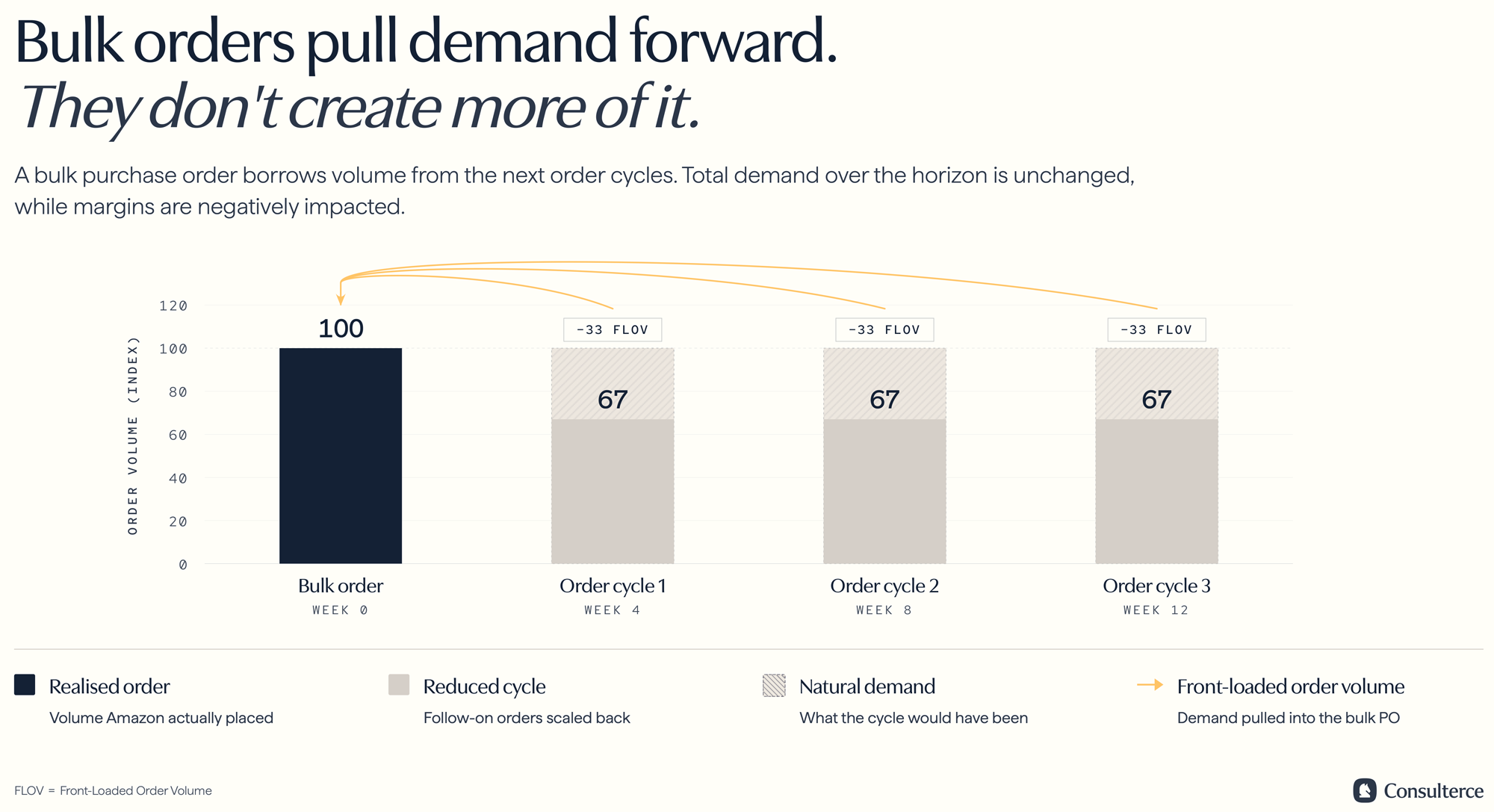
From my work with hundreds of clients over the years, the one observation that speaks most against accepting bulk buy requests is the lack of incrementality. Bulk buys forward demand; they don’t create it.
Since Amazon is a marketplace that simply connects existing demand with the supply of brands, Amazon will place those orders anyway as part of the normal weekly order replenishment cycle (at the full cost price). Not immediately, but over the course of the following weeks and months.
Pro Tip: If you want to bring forward demand, use tools like Born-to-Run. They give you a far more controlled and strategic way to requesting additional order volumes – often at a far lower cost to your business.
2. Net PPM Margin Headwinds YoY
The other point to consider when evaluating bulk buys is that any given discount will reflect in your Net PPM. That means if you give Amazon a cost price discount of 10% for placing the bulk order, you’re effectively conceding margin to Amazon’s Net PPM.
This matters, because if you’re not prepared to repeat the same discount over time, the lack of a renewed discount will form a Net PPM headwind year-over-year that your Vendor Manager will seek compensation for in the future.
A good rule of thumb when considering granting bulk-buy discounts is this: only accept them if you’re prepared to repeat the same discount in a year’s time.
3. Weaker negotiation position
Lastly, bulk buys also quietly undermine your position in annual negotiations. When Amazon builds up inventory through discounted forward buys, your Vendor Manager has no incentive to return to the negotiation table quickly.
This lack of immediate purchasing can shift the balance of power dramatically. Putting you and your teams under pressure when having to deliver the AVN within a certain time frame, all while Amazon can implement PO stoppages at virtually no cost to its customer experience.
When to accept a bulk buy offer
Now, don’t get me wrong: bulk buys aren’t always bad. But they should be used deliberately, not opportunistically. Clearing excess inventory, especially if you’re approaching shelf-life constraints, is one of the most valid use cases for accepting Amazon’s bulk buy requests.
They can also make sense when you want to strategically pull forward demand or unlock economies of scale. For example, to improve production efficiency, reduce unit costs, or smooth your supply chain.
The key is that the benefit must clearly outweigh the margin concessions I’ve explained before. So make sure you calculate this down to the basis point. And if you’re in doubt, simply don’t accept the bulk order request.
Pro Tip: The discount requested for bulk orders can often be negotiated. Reach out to your Vendor Manager or AVS, as they often have room to adjust the discount. Pushing back and asking for a lower discount can protect your bottom line while still securing the forward-buy.
The bottom line
Bulk buys aren’t a growth strategy. They’re a trade-off between short-term growth and long-term margin concessions. Most 1P vendors are better off protecting their customer P&L by not accepting bulk orders in Vendor Central. Accept them only when they serve a clear strategic purpose – not just because Amazon is asking for them.
Want help building a more resilient Amazon business?
Whether you want to upskill your team or discuss a concrete margin challenge. I offer tailored consulting services that help 1P brands run a more profitable business with Amazon. If you want to learn more, get in touch.

Martin Heubel
I’m the founder of Consulterce and commercial strategy consultant, based in London, UK. I help global CPG and household brands reliably increase their margins with Amazon.